Product Overview
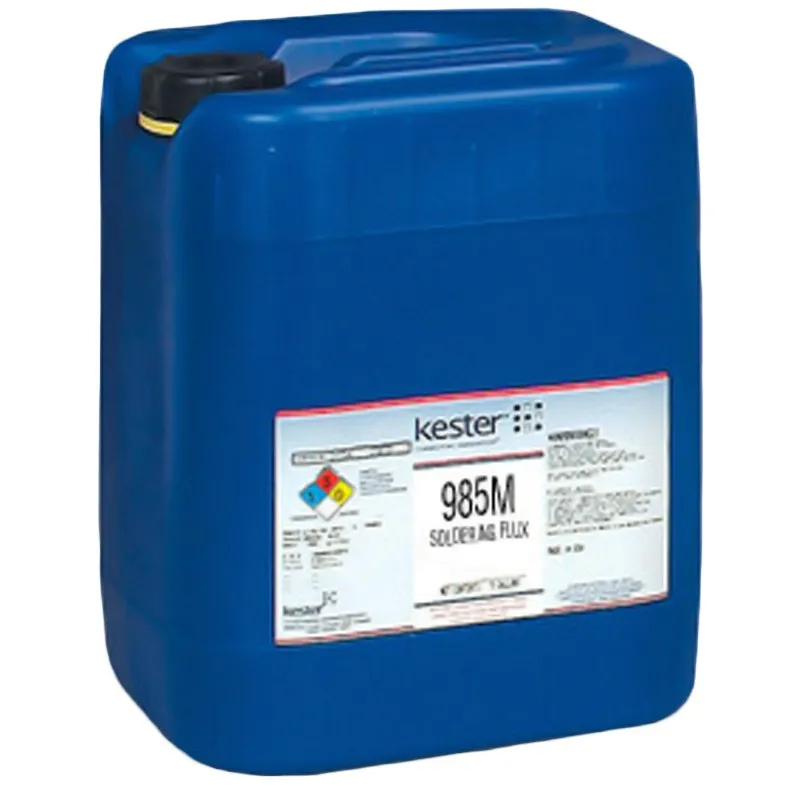
Kester 985M is broad spectrum, halide-free liquid flux, developed for use in both traditional tin-lead and lead-free solder alloys.
The unique activation package of Kester 985M makes it a wide process window flux suitable on both standard and high density assemblies.
This flux exhibits excellent wetting properties to minimize solder bridges and solder balls during all soldering operations. The residues are minimal and not apparent, excellent for pin testing.
Key Features
Halide-Free
Broad Spectrum Liquid Flux for General Wave Soldering Application
Excellent Soldering Performance Excellent soldering performance with good hole-fill and low bridging on high density assemblies.
High Reliability Meeting the Toughest ECM/SIR IPC 004B Requirements
Evenly, Tack Free and Pin Testable Residues
ORM0 per IPC J-STD-004B
Low Solid, Broad Spectrum, High Activity Flux
Kester 985M flux is a low-solids, no-clean flux, specially designed to improve effectiveness in the wave soldering of conventional circuit board assemblies.
Kester 985M is excellent for solderability to a variety of board finishes.
It provides excellent soldering on difficult lead-free wave soldering applications, even after double-sided reflow.
The minimal remaining residue is non-tacky so that boards are cosmetically clean as they exit the wave solder machine.
View Detailed Technical Specifications
Technical Data
Physical Properties
| Category | Results | Procedure/Remarks |
|---|---|---|
| Specific Gravity | 0.805 | @ 25 °C (typical) |
| Acid Number (Typical) | 20.0 mg KOH/g of flux | |
| Percent Solids (Theoretical) | 3.6% |
Reliability Properties
| Category | Results | Procedure/Remarks |
|---|---|---|
| Copper Mirror Corrosion | No Breakthrough “L” | Tested to J-STD-004B, IPC-TM-650, Method 2.3.32 |
| Corrosion Test | No Corrosion “L” Minor Corrosion “M” | Tested to J-STD-004, IPC-TM-650, Method 2.6.15B Tested to J-STD-004B, IPC-TM-650, Method 2.6.15C |
| Bono Corrosion Test | Pass, Fc=0.7% | Test Conditions: 85 °C, 85% RH, 15 days, 12V |
| Silver Chromate | Pass | Tested to J-STD-004, IPC-TM-650, Method 2.3.33 |
| Chloride & Bromide | None Detected | Tested to J-STD-004, IPC-TM-650, Method 2.3.35 |
| Fluorides by Spot Test | Pass | Tested to J-STD-004, IPC-TM-650, Method 2.3.35.1 |
| Electrochemical Migration (ECM) | Pass | Tested to J-STD-004B, IPC-TM-650, Method 2.6.14.1 Tested Conditions: 65 °C, 85% RH, 500hrs, 100V |
| Surface Insulation Resistance (SIR), Bellcore, IPC | Pass | GR-78 13.1.3 Tested Conditions: 35 °C, 85% RH, 4 Days, 100V |
| Surface Insulation Resistance (SIR) | Pass | Tested to J-STD-004B, IPC-TM-650, Method 2.6.3.7 Tested Conditions: 40 °C, 90% RH, 7 Days, 12.5V |
| Surface Insulation Resistance (SIR) | Pass | Tested to J-STD-004, IPC-TM-650, Method 2.6.3.3 Tested Conditions: 85 °C, 85% RH, 7 Days, 100V |
Flux Application
985M is specially designed for spray and wave applications. It is not designed to be used in a foam application. The flux deposition target should start at 90 to 190 μg of solids/cm² (600 to 1200 μg of solids/in²).
Processing Guidelines
The optimum preheat temperature for most circuit assemblies is 85 to 105 °C (185 to 221 °F) as measured on the top or component side of the assembly. It is important to note that the optimum preheat temperature for a given assembly will depend on the combination of machine design, circuit board design (board mass or size and component mix), board thickness, length of contact time with molten solder, solder wave shape, speed of solder flow, preheating time and alloy used in the solder pot. The key is to preheat the board to start the activation of the flux yet not burn it up prior to reaching the solder pot. For 985M, the maximum preheat temperature on the bottom side of the board is 130 °C.
Leaded solders (Sn63Pb37) will require a dwell time of 2 to 4 seconds. Lead-free solders (Sn96.5Ag3.0Cu0.5) will require a dwell time in the wave of 4 to 7 seconds. Any time greater than 7 seconds, copper dissolution for OSP, ImAg, and ImSn boards may occur.
The above information is a guideline and it is advisable to note that the optimum settings for a given assembly may vary and this is dependent on the circuit board design, board thickness, components used and equipment used. A design of experiment is recommended to be done to optimize the soldering process. If you have any questions, please contact Kester Technical Support.
Touch-Up Application
Flux pens should only be used as a last resort. Any flux applied to the solder location should be kept to the location of the solder connection being soldered.
Flux Control
Kester PS-22 Test Kit and procedure are available to insure the level of solids in the flux. The instructions of how to use this kit will come with the purchase of the kit. This could be used as a means of incoming inspection.
Cleaning
985M residues are non-conducive and do not require removal in most applications. If residue removal is required it can be removed using commercially available flux residue cleaner. Contact MacDermid Alpha Technical Support for additional assistance.
Storage, Handling and Shelf Life
985M is flammable. Store away from sources of ignition. Shelf life is 1 year from the date of manufacture when handled properly and held at 10 to 25 °C (50 to 77 °F).