Halogen-Free Low Solids No-Clean

ALPHA® EF-6808HF
Liquid Soldering Flux

A halogen-free, low solids, alcohol-based, no-clean flux for a variety of automated and manual soldering applications. Demonstrates exceptional hole-fill capabilities in high-density assemblies.

Product Overview

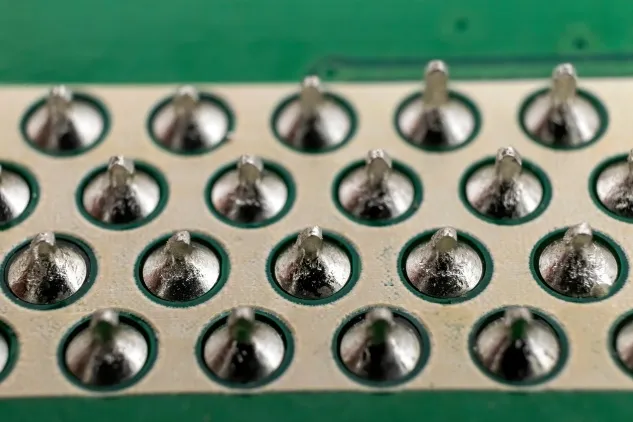
ALPHA EF-6808HF is a halogen-free, low solids, alcohol-based, no-clean flux for a variety of automated and manual soldering applications. While it can be used for various types of assemblies, this flux product demonstrates exceptional hole-fill capabilities on high-density component assemblies.

In addition, ALPHA EF-6808HF flux achieves low bridging, icicling, and solder ball levels in both tin-lead and lead-free soldering processes. The flux residue is uniform, transparent, non-tacky, and highly pin-testable. ALPHA EF-6808HF has high reliability and complies with all current halogen-free industry standards.
ALPHA® EF-6808HF

Product Features

Through Hole
  • Halogen-Free
  • Broad-Spectrum Liquid Flux for General Wave Soldering Applications
  • Excellent Soldering Performance with Good Hole-Fill and Low Bridging Excellent soldering performance with good hole-fill and low bridging on high-density assemblies.
  • High Reliability Meeting the Toughest ECM/SIR IPC-004B Requirements
  • Evenly Spread, Tack-Free, and Pin-Testable Residue
  • ROL0 per IPC J-STD-004B

Halogen-Free, Broad-Spectrum,
High-Reliability Flux

ALPHA EF-6808HF soldering flux is specifically formulated to provide a safer and more environmentally friendly alternative to ordinary fluxes.

Developed using the latest Alpha flux technology, ALPHA EF-6808HF contains a unique blend of chemistries, making it a high-performance wave soldering flux for most standard assemblies, from both soldering and reliability perspectives.

With high wetting performance, it lowers the total cost of ownership by offering a wide process window, fast throughput, and a low defect rate.

Chip Detail
View Detailed Product Specifications

Application Guidelines

Preparation

In order to maintain consistent soldering performance and electrical reliability, it is important to begin the process with circuit boards and components that meet established requirements for solderability and ionic cleanliness. It is suggested that assemblers establish specifications on these items with their suppliers and that suppliers provide Certificates of Analysis with shipments and/or assemblers perform incoming inspection. A common specification for the ionic cleanliness of incoming boards and components is 5µg/in² maximum, as measured by an Omegameter with heated solution.

Care should be taken in handling the circuit boards throughout the process. Boards should always be held at the edges. The use of clean, lint-free gloves is also recommended.

Conveyors, fingers and pallets should be cleaned. Alpha Auto Clean 40 is recommended for this process.

Control

ALPHA EF-6808HF flux is designed to be applied by spray application. The uniform application of flux is critical to successful soldering. A series of tests should be run when setting up the fluxer, to ensure uniform flux application. The flux should penetrate all the plated through-holes on the board to the top side, but should not flood the topside. There are a number of methods to test this. Contact your local Alpha Technical Services Representative for more information. Depending on the alloy and production program, users can use the following table as a soldering reference.

Operating Parameter Recommendation
Flux ApplicationSpray
Amount of Flux AppliedSingle Wave: 800 – 1,200 µg/in² of solids
Dual Wave: 1,200 – 1,600 µg/in² of solids
Topside Preheat Temperature80 – 115 °C
Bottomside Preheat Temperature100 – 135 °C
Maximum Topside Ramp Rate (to avoid component damage)2 °C/second (35 °F/second) maximum
Conveyor Speed1.0 – 1.5 m/min
Contact Angle4 – 6°
Contact Time2 – 5 seconds
Solder Pot Temperature250 – 275 °C

These are general guidelines which have proven to yield excellent results; however, depending upon your equipment, components, and circuit boards, your optimal settings may be different. In order to optimize your process, it is recommended to perform a design of experiment, optimizing the most important variables (amount of flux applied, conveyor speed, topside preheat temperature, solder pot temperature and board orientation).

Residue Removal

ALPHA EF-6808HF is a no-clean flux and the residues are designed to be left on the board. If desired, flux residues can be removed with ALPHA 2110 saponifier cleaner and with other commercially available solvent cleaners and saponifier cleaners.

Halogen Status

Standard Requirement Test Method Status
IEC 61249-2-21 Post Soldering Residues contain <900ppm each or total of <1500ppm Br or Cl from flame retardant source TM EN 14582
Extraction of Solids according to IPC TM 2.3.34
Pass
JEITA ET-7304
Definition of Halogen Free Soldering Materials
<1000ppm Br, Cl and F in solder material solids Pass
JEDEC
A Guideline for Defining "Low Halogen" Electronics
Post soldering residues contain <1000ppm Br or Cl from flame retardant source Pass

Technical Data

Physical Properties Typical Values Parameters/Test Method Typical Values
AppearanceClear, Light Amber LiquidFlash Point (T.C.C.)17 °C
Solids Content, wt/wt4.0%Recommended ThinnerALPHA 425
Specific Gravity @ 25 °C (77 °F)0.793 +/- 0.005Shelf Life (from Date of Mfg.)360 Days
Acid Number (mg KOH/g)19.4 +/- 2IPC J-STD-004B DesignationROL0

Corrosion & Electrical Testing – SAC305 Alloy

Corrosion Testing

Test Requirement for ROL0 Results
Silver Chromate Paper (IPC-TM 650, Test Method 2.3.33)No detection of halidePass
Copper Mirror Tests (IPC-TM 650, Test Method 2.3.32)No complete removal of copperPass
Copper Corrosion Test (IPC-TM 650, Test Method 2.6.15)No evidence of corrosionPass
JIS Copper Corrosion Test (JIS Z3197-1999, Test Method 8.4.1)No evidence of corrosionPass

IPC J-STD-004B Surface Insulation Resistance

Test Requirements (May <1.0 x 10⁸ in the first 24 hrs) Results (min of all recorded values)
Less than 24 hrs
Results (min of all recorded values)
24 – 168 hrs
Visual
"Comb-Down" Un-cleaned>1.0 x 10⁸ Ω1.3 x 10⁸ Ω6.0 x 10⁸ ΩPass
"Comb-Up" Un-cleaned>1.0 x 10⁸ Ω1.2 x 10⁹ Ω3.6 x 10¹⁰ ΩPass
Control Boards>1.0 x 10⁹ Ω1.4 x 10¹¹ Ω2.3 x 10¹¹ ΩN/A

IPC Test Condition (per J-STD-004B, Test Method 2.6.3.7): IPC B-24 coupon, 12V, 40 ºC, 90% RH, measurements recorded every 20 minutes

IPC J-STD-004B Electrochemical Migration Resistance

Test SIR (Initial) SIR (Final) Requirement Result Visual
"Comb-Up" Un-cleaned1.2 x 10¹¹ Ω2.7 x 10¹¹ ΩSIR (Final) ≧ SIR (Initial) / 10PassPass
"Comb-Down" Un-cleaned1.1 x 10¹⁰ Ω9.8 x 10⁹ ΩSIR (Final) ≧ SIR (Initial) / 10PassPass
Control Boards>1.0 x 10¹² Ω>1.0 x 10¹² ΩN/APassPass

IPC Test Condition (per J-STD-004B, Test Method 2.6.14.1): IPC B-25 coupon, 65 °C, 88.5% RH, 500 Hours