
Product Overview
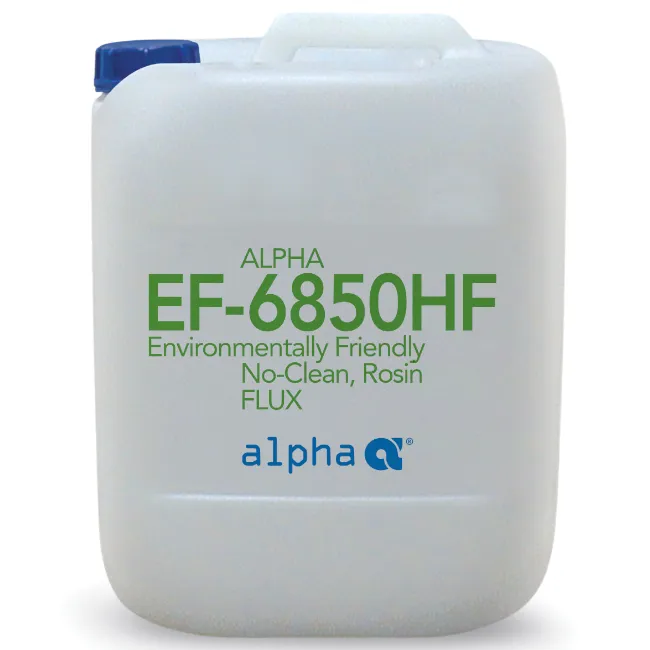
ALPHA EF-6850HF is a Halogen-Free, low solids, alcohol based, no clean flux for lead-free wave soldering. It is formulated for both standard and thicker, high-density PCBs used in Pb-free applications.
It is designed for low bridging, as well as, to provide superior performance in pin testing, hole-fill and solderballing. Additionally, it provides good cosmetics with a uniform, tack free residue.
Key Features & Benefits
Halogen Free Environmentally friendly. Complies with halogen free industry standards.
Unique activator / package Produces highly reliable assemblies with excellent cosmetics and pin testability.
Low surface tension High through hole penetration rate and uniform SMT pad coverage.
Thermally stable Excellent soldering in both single and dual wave processing using SAC305 or other low silver alloys.
Tack free residue Pin testable, uniform, transparent, tack free residue.
View Detailed Technical Specifications
APPLICATION GUIDELINES
PREPARATION: In order to maintain consistent soldering performance and electrical reliability, it is important to begin the process with circuit boards and components that meet established requirements for solderability and ionic cleanliness. It is suggested that assemblers establish specifications on these items with their suppliers and that suppliers provide Certificates of Analysis with shipments and/or assemblers perform incoming inspection. A common specification for the ionic cleanliness of incoming boards and components is 10 µg/in² maximum, as measured by an Omegameter with heated solution.
Care should be taken in handling the circuit boards throughout the process. Boards should always be held at the edges. The use of clean, lint-free gloves is also recommended.
Conveyors, fingers and pallets should be cleaned regularly to reduce the build-up of flux residues. ALPHA AutoClean 40 cleaner is recommended for this process.
FLUX APPLICATION: ALPHA EF-6850HF can be applied by spray, foam or wave application. A uniform coating of flux is essential to successful soldering. When applying flux, it is important to run a series of tests to ensure that the flux is being applied uniformly, that it is penetrating from top to bottom of the board on all holes to be soldered and to make sure that excessive amounts of flux are not being applied.
| OPERATING PARAMETER | SAC 305 or Low Ag SAC alloys |
|---|---|
| Amount of Flux Applied | Single : 1,200 – 1,600 µg/in² solids Dual : 1,400 – 2,000 µg/in² solids |
| Top-Side Preheat Temperature | 90 - 120°C |
| Bottom side Preheat Temperature | 110 - 140°C |
| Recommended Preheat Profile | Straight ramp to desired top-side temperature |
| Maximum Ramp Rate of Topside Temperature (to avoid component damage) | 2°C/second (35°F/second) maximum |
| Contact Time in the Solder (includes Chip Wave and Primary Wave) | 3 – 6 seconds |
| Solder Pot Temperature: | 255-265°C |
FLUX SOLIDS CONTROL & RESIDUE REMOVAL
FLUX SOLIDS CONTROL: If rotary drum spray fluxing, the flux solids will need to be controlled via thinner addition. For measuring the solids content, Alpha's Flux Solids Control Kit #3, a digital titrator, is suggested. Request Alpha's Technical Bulletin SM-458 for details on the kit and titration procedure. When operating a rotary drum fluxer continuously, the acid number should be checked every eight hours. Over time, debris and contaminants will accumulate in recirculating type flux applicators. For consistent soldering performance, dispose of spent flux every 40 hours of operation. After emptying the flux, the reservoir should be thoroughly cleaned with IPA.
RESIDUE REMOVAL: ALPHA EF-6850HF is a no-clean flux and the residues are designed to be left on the board. If desired, flux residues can be removed with Alpha 2110 saponifier cleaner and with other commercially available solvent cleaners and saponifier cleaners.
TECHNICAL SPECIFICATIONS
| Physical Properties | Typical Values | Parameters/Test Method | Typical Values |
|---|---|---|---|
| Appearance | Clear, Light Amber | pH, 5% v/v aqueous solution | 2.8 |
| Solids Content, wt/wt | 4.0% | Recommended Thinner | ALPHA 425 |
| Specific Gravity @ 25°C (77°F) | 0.793 | Shelf Life | 12 months |
| Acid Number (mg KOH/g) | 21.47 | IPC J-STD-004 Designation | ROL0 |
| Flash Point (T.C.C.) | 17°C |
SAFETY
Consult the SDS for all safety information. The most recent version of the SDS is available from alphaassembly.com. Inhalation of the volatilized flux activator fumes, which are generated at soldering temperatures, may cause headaches, dizziness and nausea. Suitable fume extraction equipment should be used to remove the flux from the work area. An exhaust at the exit end of the wave solder machine may also be needed to completely capture the fumes. Observe precautions during handling and use. Suitable protective clothing should be worn to prevent the material from coming in contact with skin and eyes.
HALOGEN CLASS
| Standard | Requirement | Test Method | Status |
|---|---|---|---|
| IEC 61249-2-21 | Post soldering residues contain <900ppm each or total of <1500ppm Br or Cl from flame retardant source | TM EN 14582 Solids extraction per IPC TM 2.3.34 | PASS |
| JEDEC - A Guideline for Defining “Low Halogen” Electronic products | Post soldering residues contain <1000ppm Br or Cl from flame retardant source | PASS |
CORROSION & ELECTRICAL TESTING – SAC305 ALLOY
CORROSION TEST
| Test | Requirement for ROL0 | Results | |
|---|---|---|---|
| IPC | Silver Chromate Paper IPC-TM 650 Test Method 2.3.33 | No detection of halide | PASS |
| Copper Mirror Test IPC-TM 650 Test Method 2.3.32 | No complete removal of copper | PASS | |
| Copper Corrosion Test IPC-TM650 Test Method 2.6.15 | No evidence of corrosion N/A | PASS | |
| JIS | Copper Corrosion Test JIS Z3197-1999 Test Method 8.4.1 | No evidence of corrosion | PASS |
IPC J-STD-004B SURFACE INSULATION RESISTANCE
| Test | Requirements (<1.0 x 10⁸ allowed during initial 24 hrs.) | Results (min. of all measurements recorded) | ||
|---|---|---|---|---|
| < 24 Hrs | 24 – 168 Hrs | Visual | ||
| "Comb-Down" Un-cleaned | > 1.0 x 10⁸ Ω | 6.8 x 10¹⁰ Ω | 6.2 x 10¹⁰ Ω | PASS |
| "Comb-Up" Un-cleaned | > 1.0 x 10⁸ Ω | 1.4 x 10¹⁰ Ω | 2.7 x 10¹⁰ Ω | PASS |
| Control Boards | > 1.0 x 10⁹ Ω | 1.8 x 10¹¹ Ω | 1.8 x 10¹¹ Ω | NA |
IPC Test Condition (per J-STD-004B TM2.6.3.7): IPC B-24 coupons, 12V, 40ºC, 90% RH, measurements recorded @ 20min intervals
JIS STANDARD SURFACE INSULATION RESISTANCE
| Test | Conditions | Requirements | Controls | Results |
|---|---|---|---|---|
| Initial | Ambient | > 1.0 x 10¹¹ Ω | 9.7 x 10¹¹ Ω | 9.8 x 10¹¹ Ω |
| After 7 days | 40°C / 90% RH | > 1.0 x 10¹⁰ Ω | 1.0 x 10¹² Ω | 7.5 x 10¹¹ Ω |
| Recovered | 25°C/75% RH, 7 days | > 1.0 x 10¹¹ Ω | 1.0 x 10¹² Ω | 1.0 x 10¹² Ω |
All Measurements @ 100V, JIS Boards (0.32mm lines, 0.32 mm spacing, same as IPC B25 Boards).
BELLCORE SURFACE INSULATION RESISTANCE
| Test | Conditions | Requirements¹ | Results¹ |
|---|---|---|---|
| "Comb-Down" Un-cleaned | 35°C/85% RH, 4 days | > 1.0 x 10¹¹ Ω | 3.6 x 10¹¹ Ω |
| "Comb-Up" Un-cleaned | 35°C/85% RH, 4 days | > 1.0 x 10¹¹ Ω | > 1.0 x 10¹² Ω |
| Control Boards | 35°C/85% RH, 4 days | > 2.0 x 10¹¹ Ω | > 1.0 x 10¹² Ω |
Bellcore Test Condition (per GR 78-CORE, Issue 1: 48 Volts, measurement @ 100V/25 mil lines/50 mil spacing.
BELLCORE ELECTROMIGRATION
| Test | SIR (Initial)¹ | SIR (Final)¹ | Requirement | Result | Visual Result |
|---|---|---|---|---|---|
| "Comb-Up" Un-cleaned | 1.0 x 10¹¹ Ω | 3.5 x 10¹¹ Ω | SIR (Initial)/SIR (Final) <10 | 0.29 | PASS |
| "Comb-Down" Un-cleaned | 2.1 x 10¹⁰ Ω | 6.5 x 10¹⁰ Ω | SIR (Initial)/SIR (Final) <10 | 0.32 | PASS |
| Control | 1.0 x 10¹¹ Ω | 5.9 x 10¹¹ Ω | Not applicable | 0.17 | PASS |
Bellcore Test Condition (per GR 78-CORE, Issue 1): 65°C/85% RH/500 Hours/10V, measurement @ 100V/IPC B-25B Pattern (12.5 mil lines, 12.5 mil spacing).