
Product Overview
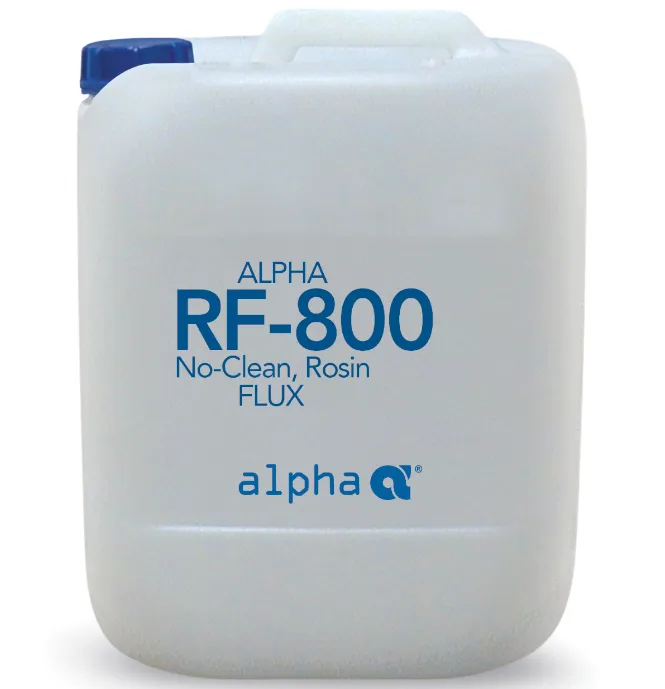
ALPHA RF-800 provides the broadest process window for a no-clean flux with less than 5% solids content. ALPHA RF-800 is designed to provide excellent soldering results (low defects rates), even when the surfaces to be soldered (component leads and pads) are not highly solderable.
RF-800 works particularly well with bare copper boards protected with organic or rosin/resin coatings and with tin-lead coated PCB’s. ALPHA RF-800 is used successfully in both tin-lead and lead-free applications.
Key Features
Highly active for excellent soldering and low defect rates.
Low level of non-tacky residue to reduce interference with pin testing.
Cleaning is not required which reduces operating costs.
Reduces the surface tension between solder mask and solder to significantly reduce solder ball frequency.
Meets Bellcore requirements for long-term electrical reliability.
Supplied in either 10 or 25 Litre containers.
View Detailed Technical Specifications
APPLICATION GUIDELINES
PREPARATION
In order to maintain consistent soldering performance and electrical reliability, it is important to begin the process with circuit boards and components that meet established requirements for solderability and ionic cleanliness. It is suggested that assemblers establish specifications on these items with their suppliers and that suppliers provide Certificates of Analysis with shipments and/or assemblers perform incoming inspection. A common specification for the ionic cleanliness of incoming boards and components is 5µg/in2 maximum, as measured by an Omegameter with heated solution.
Care should be taken in handling the circuit boards throughout the process. Boards should always be held at the edges. The use of clean, lint-free gloves is also recommended. When switching from one flux to another, the use of a new foam stone is recommended (for foam fluxing).
Conveyors, fingers and pallets should be cleaned. ALPHA SM-110 Solvent Cleaner has been found to be very useful for these cleaning applications. When foam fluxing, do not use hot fixtures or pallets. Hot fixtures/pallets will deteriorate the foam head.
FLUX APPLICATION
ALPHA RF-800 is formulated to be applied by foam, wave or spray methods. When foam fluxing, the foam fluxer should be supplied with compressed air which is free of oil and water.
Keep the flux tank full at all times. The flux level should be maintained 1 inch to 1-½ inches above the top of the stone. Adjust the air pressure to produce the optimum foam height with a fine, uniform foam head.
A uniform coating of flux is essential to successful soldering. When using the foam or wave method of application, an air knife is recommended after the fluxing operation. An air knife will help ensure that the flux is uniformly distributed across the board and will remove the excess flux. When spray fluxing, the uniformity of the coating can be visually checked by running a piece of cardboard over the spray fluxer or by processing a board-sized piece of tempered glass through the spray and then through the preheat section.
| OPERATING PARAMETER | SAC305/SACX0307 | 63Sn/37Pb |
|---|---|---|
| Amount of Flux Applied | Single Wave: 1000-1200 µg/in² of solids Dual Wave: 1100-1500 µg/in² of solids |
Foam: 1,000 - 2,000 µg/in² of solids Spray: 750 - 1,500 µg/in² of solids |
| When foam fluxing | ||
| Foam Stone Pore Size | 20 -50 µm | 20 -50 µm |
| Distance that top of stone is submerged below flux | 1 - 1½ inches (25 - 40 mm) | 1 - 1½ inches (25 - 40 mm) |
| Foam Fluxer Chimney Opening | 3/8 - 1/2 inch (10-13 mm) | 3/8 - 1/2 inch (10-13 mm) |
| When foam fluxing, use an Air Knife | ||
| Air Knife Hole Diameter | 1 - 1.5 mm | 1 - 1.5 mm |
| Distance Between Holes | 4 - 5 mm | 4 - 5 mm |
| Distance from Fluxer to Air Knife | 4 - 6 inches (10-15 cm) | 4 - 6 inches (10-15 cm) |
| Air Knife Angle Back toward Fluxer from Perpendicular | 3° - 5° | 3° - 5° |
| Topside Preheat Temperature | 190° - 247°F (85° - 120°C) | 190°F – 230°F (85°C - 110°C) |
| Bottomside Preheat Temperature | about 65°F (35°C) higher than topside | about 65°F (35°C) higher than topside |
| Maximum Ramp Rate of Topside Temperature | 2°C/second (3.5°F/second) maximum | 2°C/second (3.5°F/second) maximum |
| Conveyor Angle | 5°-8° (6° most common) | 5°-8° (6° most common) |
| Conveyor Speed | 3 – 6 feet/minute (0.9 – 1.8 meters/minute) | 4 - 6 feet/minute (1.2 - 1.8 meters/minute) |
| Contact Time in the Solder (includes ChipWave and Primary Wave) | 1.5 - 3.5 seconds (2-2½ seconds most common) | 1.5 - 3.5 seconds (2-2½ seconds most common) |
| Solder Pot Temperature | 490° - 520°F (250° - 270°C) | 460° – 500°F (235°-260°C) |
These are general guidelines which have proven to yield excellent results; however, depending upon your equipment, components, and circuit boards, your optimal settings may be different. In order to optimize your process, it is recommended to perform a designed experiment, optimizing the most important variables (amount of flux applied, conveyor speed, preheat temperatures, and solder pot temperature and board orientation).
FLUX SOLIDS CONTROL
If foam, wave, or rotary drum, spray fluxing, the flux solids will need to be controlled via thinner addition to replace evaporative losses of the flux solvent. As with any flux with less than 5% solids content, specific gravity is not an effective measurement for assessing and controlling the solids content. Monitoring and controlling the acid number is recommended for maintaining the solids content. The acid number should be controlled to between 17 and 19. Alpha's Flux Solids Control Kit #3, a digital titrator, is suggested. Request Alpha's Technical Bulletin SM-458 for details on the kit and titration procedure. When operating the foam fluxer continuously, the acid number should be checked every two to four hours. Over time, debris and contaminants will accumulate in recirculating type flux applicators. For consistent soldering performance, dispose of spent flux every 40 hours of operation. After emptying the flux, the reservoir and foam stone should be thoroughly cleaned with flux thinner.
RESIDUE REMOVAL
ALPHA RF-800 is a no-clean flux and the residues are designed to be left on the board. However, if desired, ALPHA RF-800 residues can be removed with ALPHA 2110 Saponifier.
TOUCH-UP/REWORK
Use of the Cleanline Write Flux Applicator with ALPHA NR205 flux and ALPHA Telecore Series cored solder wire is recommended for hand soldering applications.
TECHNICAL DATA
| Parameters | Typical Values | Parameters/Test Method | Typical Values |
|---|---|---|---|
| Appearance | Pale, yellow liquid | pH (5% aqueous solution) | 3.4 |
| Solids Content, %wt/wt | 4.1 | Recommended Thinner | ALPHA 425 |
| Acid Number (mg KOH/g) | 18.0 ± 1.0 | Shelf Life (from Date of Mfg.) | 540 days |
| Specific Gravity @ 25°C (77°F) | 0.794 ± 0.003 | Container Size Availability | 1, 5, and 55 Gallons; 20 Liters |
| Pounds Per Gallon | 6.6 | Bellcore TR-NWT-000078, Issue 3 Compliant | Yes |
| Flash Point (T.C.C.) | 56°F (13°C) | IPC J-STD-004 Designation | ROL0 |
CORROSION & ELECTRICAL TESTING – SAC305 ALLOY
CORROSION TESTING
| Corrosion Testing | Requirement | Results |
|---|---|---|
| Silver Chromate Paper Test | No Detection of Halide | PASS |
| Copper Mirror Test | No Complete Removal of Copper | PASS |
| IPC Copper Corrosion Test | No evidence of corrosion | No Corrosion (Type L) |
IPC J-STD-004A SURFACE INSULATION RESISTANCE
| Test | Conditions | Requirements | Results |
|---|---|---|---|
| "Comb-Down" Un-cleaned | 85°C/85% RH, 7 days | > 1.0 x 10⁸ Ω | 1.1 x 10¹⁰ Ω |
| "Comb-Up" Un-cleaned | 85°C/85% RH, 7 days | > 1.0 x 10⁸ Ω | 9.8 x 10⁹ Ω |
| Control Boards | 85°C/85% RH, 7 days | > 1.0 x 10⁹ Ω | 1.1 x 10¹⁰ Ω |
IPC Test Condition (per J-STD-004A): -50V, measurement @ 100V/IPC B-24 board (0.4 mm lines, 0.5 mm spacing).
BELLCORE SURFACE INSULATION RESISTANCE
| Test | Conditions | Requirements | Results |
|---|---|---|---|
| "Comb-Down" Un-cleaned | 35°C/85% RH, 4 days | > 1.0 x 10¹¹ Ω | 7.0 x 10¹³ Ω |
| "Comb-Up" Un-cleaned | 35°C/85% RH, 4 days | > 1.0 x 10¹¹ Ω | 4.6 x 10¹³ Ω |
| Control Boards | 35°C/85% RH, 4 days | > 2.0 x 10¹¹ Ω | 3.1 x 10¹³ Ω |
Bellcore Test Condition (per TR-NWT-000078, Issue 3: 48 Volts, measurement @ 100V/25 mil lines/50 mil spacing.
BELLCORE ELECTROCHEMICAL MIGRATION RESISTANCE
| Test | SIR (Initial) | SIR (Final) | Requirement | Result | Visual Result |
|---|---|---|---|---|---|
| "Comb-Up" Un-cleaned | 3.0 x 10⁹ | 3.8 x 10⁹ | SIR (Initial)/SIR (Final) < 10 | PASS | PASS |
| "Comb-Down" Un-cleaned | 2.8 x 10⁹ | 4.0 x 10⁹ | SIR (Initial)/SIR (Final) < 10 | PASS | PASS |
Bellcore Test Condition (per TR-NWT-000078, Issue 3): 85°C/85%RH/500 Hours/10V, measurement @ 100V/IPC B-25 B Pattern (12.5 mil lines, 12.5 mil spacing)