Halogen-Free No-Clean High Reliability

ALPHA® CVP-390V
No-Clean Solder Paste

High electrochemical reliability, halogen-free, lead-free no-clean solder paste 鈥?engineered for demanding environments and next-generation high-density assembly.

Product Overview

ALPHA CVP-390V is a halogen-free solder paste that delivers best-in-class electrochemical reliability, even at 0.100 mm comb spacing 鈥?among the most challenging Surface Insulation Resistance (SIR) test conditions. Its compatibility with Innolot alloys and the ability to maintain superior electrochemical performance in high-density assembly designs make it the ideal choice for next-generation high-reliability applications.

ALPHA CVP-390V is formulated to be compatible with finer powder types, delivering >2.00 Cpk for transfer efficiency between 60 % and 120 % under variable print process conditions at area ratios as low as 0.60, offering exceptional manufacturing flexibility. The paste also maintains repeatable transfer efficiency on miniature 01005 components and exhibits excellent coalescence on 170 碌m round and square apertures.
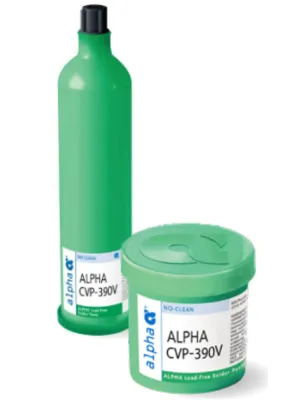
ALPHA® CVP-390V Solder Paste product family

Key Benefits

Excellent pin-testability for high first-pass yield
Superior electrochemical performance on fine-pitch components
Outstanding coalescence on 170 碌m apertures
Compatible with SAC305 and Innolot high-reliability alloys

Electrochemical Reliability

ALPHA CVP-390V is engineered for outstanding electrochemical performance in the most demanding applications. The paste maintains Log SIR >8 under severe condensing conditions (e.g. automotive damp-heat profiles), and meets IPC-J-STD-004B requirements down to 0.100 mm spacing in advanced SIR tests with covered components.

Combined with Innolot alloy compatibility, ALPHA CVP-390V is among the most reliable solder paste solutions available on the market today.
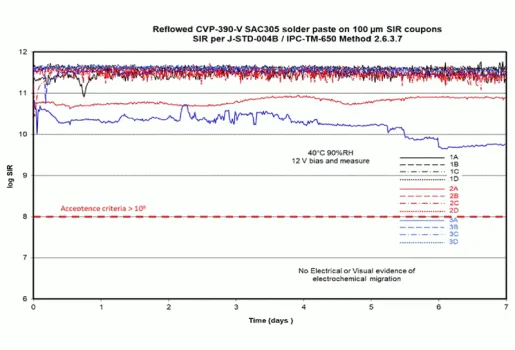
CVP-390V SIR test performance graph
CVP-390V performance on 100 碌m SIR test board

High Throughput & High Yield

Fine-feature precision printing detail
Excellent fine-feature printing capability

Our advanced solder paste is designed to deliver high throughput, improved yield, and the lowest total cost of ownership across a wide range of applications 鈥?including fine-feature printing, low-temperature processes, and low-voiding requirements.

  • Excellent fine-feature printing
  • Compatible with low-temperature process requirements
  • Outstanding low-voiding performance
View Detailed Product Specifications

Product Description

ALPHA CVP-390V is a lead-free, no-clean solder paste designed to maximize manufacturing flexibility and impart excellent electrochemical reliability in harsh operating conditions. ALPHA CVP-390V provides stable printing and reflow performance across a wide range of component types. Under variable print process conditions, ALPHA CVP-390V maintains transfer efficiency between 60%-120% at an area ratio >0.60 with >2.00 Cpk stability, ensuring maximum manufacturing flexibility. ALPHA CVP-390V maintains repeatable transfer efficiency on miniature 01005 components and exhibits excellent coalescence on 170碌m round and square apertures. ALPHA CVP-390V delivers best-in-class electrochemical reliability, achieving 0.100mm comb spacing in the most challenging Surface Insulation Resistance (SIR) tests. Capable of handling harsh operating conditions and maintaining high electrochemical performance in high-density assembly designs, ALPHA CVP-390V is the ideal choice for high-reliability applications.

Features & Benefits

  • Excellent electrochemical reliability: Maintains 鈮?0鈦?Ohms on 100碌m pitch modified IPC-B-24 test boards under harsh 7-day SIR conditions, ensuring reliability for complex assemblies.
  • Broad process window: Delivers >2.0 Cpk transfer efficiency (between 60%-120%) at >0.60 area ratios, enabling maximum process flexibility.
  • Reliable post-reflow residue: Outstanding pin-testability ensures maximum first-pass yield.
  • Excellent reflow and coalescence: Maintains good solderability on apertures as small as 170碌m for high-density assemblies using straight ramp or soak profiles.
  • Zero Halogen / No intentional halogen addition: Ensures ROHS compliance for safe and environmentally friendly assembly processes.

Product Information

Alloy: SAC305, Innolot
Powder Size: Type 4, Type 4.5, Type 5
Packaging: 500g Jar, 600g/6 in, 1200g/12 in cartridge
Lead-Free: Complies with RoHS Directive EU/2015/863; Amendment 2011/65/EU Annex II
Halogen Content: Zero Halogen

Application Guidelines

The following process parameters are guidelines for typical SMT process windows. Due to industry variations, optimal process settings must be established for specific applications.

SpeedStencil printing, 25-150mm/s (1-6in/s). Best performance between 100-120mm/s.
PressureDepending on print speed and stencil/substrate, typical squeegee pressure is 0.21-0.36 kg/cm (1.25-2.0 lbs/in). Higher print speeds require higher pressure for a clean stencil surface.
Solder Paste RollRecommended diameter between 1.5cm (0.60in) and 2.0cm (0.80in) for optimal performance; add paste when roll reaches 1.0cm (0.40in) or smaller. Maximum roll size depends on the squeegee.
SqueegeeMetal squeegee recommended, 60掳 angle.
Stencil Release Speed>10mm/s recommended.
For AR鈮?.64 apertures, print volume is stable and does not require pre-kneading. For AR<0.64 apertures, 1-2 dummy prints are needed prior to actual printing.
ALPHA CVP-390V residues can safely remain on the board after reflow. Misprints or stencils can be cleaned with IPA.

Storage and Handling

Note: These are preliminary recommendations. All process settings should be independently verified.

Refrigerate at 0-10 掳C (32-50 掳F) to maintain stability. When stored under these conditions, the shelf life of ALPHA CVP-390V is 6 months. After refrigeration, allow paste container to warm up to room temperature for up to 4 hours. Paste temperature must reach 19 掳C (66 掳F) before use. Check paste temperature with a thermometer before loading onto printer. Paste can be stored at room temperature up to 25 掳C (77 掳F) for up to 2 weeks before use.

Manual mixing can be performed before use. No rotational/centrifugal equipment is required. If centrifugal equipment is used, mixing at 300 RPM for 30-60 seconds is sufficient.

Do not mix used paste from the stencil with unused paste in the jar, as this will alter the rheology of the unused paste.

Halogen Level

Standard Requirement Test Method Status
BS EN 14582:2016 Zero Halogen (No intentional addition) SGS Halogen Cl, Br - BS EN14582 (2016) / Combustion Not Detected
RoHS Directive EU/2015/863; Amendment 2011/65/EU Annex II IEC 62321:2013 & IEC 62321:2008 Pass
REACH SVHC concentration 鈮?0.1% SGS Internal Test Method Pass

Technical Data

Category Result Procedure/Notes
Chemical Properties
Activity LevelROL0IPC J-STD-004B
Fluoride Spot TestFluoride FreeIPC J-STD-004B
Halogen Content TestHalogen Not DetectedBS EN 14582 (2016)
Silver Chromate TestHalide FreeJIS Z 3197
Copper Mirror TestLow Activity, No BreakthroughJIS Z 3197 & IPC J-STD-004B
Copper Corrosion TestLow Activity, No CorrosionJIS Z 3197 & IPC J-STD-004B
Electrical Properties
Automotive Damp Heat Test (50V)Pass, 鈮?0鈦?Ohms (6 days)IEC 6068-2-30
SIR
(7 days, 85 掳C/85% RH, 12V)
Pass, 鈮?0鈦?Ohms (7 days) IPC J-STD-004C TM-650 2.6.3.7
SIR
(7 days, 40 掳C/90% RH)
Pass, 鈮?0鈦?Ohms (7 days) at 100渭m pitch JIS Z 3197 & IPC J-STD-004B
Electrochemical Migration Pass, No Corrosion or Migration, 596 Hours IPC J-STD-004B
Physical Properties
Residue ColorClear to light amber-
SpreadabilityAverage spread 88-90%JIS Z 3197
Stencil LifeStable transfer efficiency > 8 Hours@25 掳C / 30% RH
Cold Slump (25 掳C / 50% RH)Pass, no bridging > 0.20mmIPC J-STD-005A
Hot Slump (150 掳C / 10 min)Pass, no bridging > 0.25mmIPC J-STD-005A

Reflow Profiles

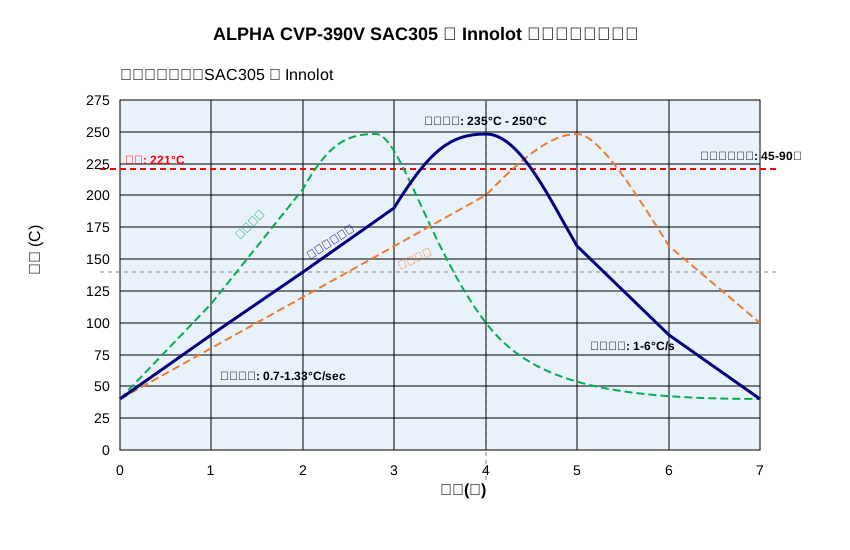
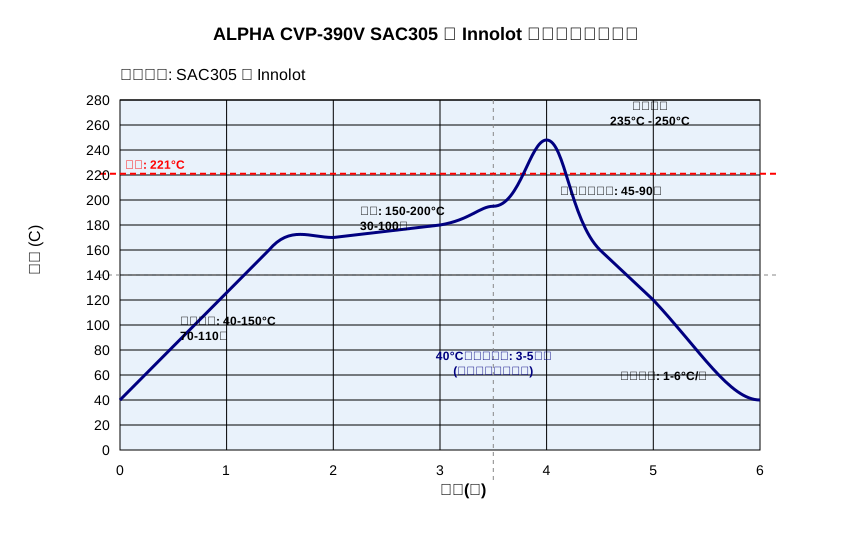
Note: Reflow environment recommended in Nitrogen or Air. Actual profiles may require adjustments depending on assembly thermal mass.

CVP-390V Straight Ramp Reflow Profile

Figure 1: ALPHA CVP-390V Recommended Straight Ramp Reflow Profile

CVP-390V High Soak Reflow Profile

Figure 2: ALPHA CVP-390V Recommended High Soak Reflow Profile

Product Documentation