
Product Overview
ALPHA CVP-520 is a lead-free, zero-halogen, no-clean solder paste designed to satisfy applications that require a low temperature reflow process. Its unique low-temp alloy melt point is below 140掳C, perfectly supporting reflow profiles with peak temperatures of 155 - 190掳C, and effectively preventing peeling and warpage of thin substrates and high-density connectors.
When assembly designs contain temperature-sensitive through-hole components or connectors, CVP-520 completely eliminates extra wave or selective soldering steps, drastically reducing assembly manufacturing costs and maximizing daily throughput.
Product Features
View Detailed Product Parameters
Product Information
42%Sn/57.6%Bi/0.4%Ag (Alpha has licenses to supply this alloy in the USA, UK, Germany, and South Korea. Patent protected: US 5,569,433; KR 400121; DE 69521762.3; UK 0711629)
42%Sn/57%Bi/1.0%Ag available upon request, 42%Sn/58%Bi
Application Guidelines
Formulated for both standard and fine pitch stencil printing, at print speeds of between 40 mm/sec (1.5 in/sec) and 100 mm/sec (4 in/sec), with stencil thickness of 0.100 mm (0.004 in) to 0.150 mm (0.006 in), particularly when used in conjunction with ALPHA Stencils. Blade pressures should be 0.18 to 0.27 kg/cm of blade (1.0 to 1.5 lb/inch), depending upon the print speed. The higher the print speed employed, the higher the blade pressure that is required to prevent smearing on the stencil. Examples of successful reflow profiles are outlined below. Generally, peak temperatures of 155 to 190 掳C have proven effective.
Technical Specifications
| Category | Results | Procedures/Remarks |
|---|---|---|
| Chemical Properties | ||
| Activity Level | ROL0 = J-STD Classification | IPC J-STD-004 |
| Halide Content | Halide-free (by titration). Passes Ag Chromate Test | IPC J-STD-004 |
| Halogen Content | Pass, Zero-Halogen - No halogen intentionally added | EN14582, by oxygen bomb combustion, Non-detectable (ND) at < 50 ppm |
| Copper Mirror Test | Pass | IPC J-STD-004 |
| Copper Corrosion Test | Pass (No Evidence of Corrosion) | IPC J-STD-004 |
| Pass (No evidence of corrosion) | JIS Z 3197:1999 8.4.1 | |
| Electrical Properties | ||
| SIR (7 days @ 85 掳C /85% RH, 12V) | Pass, 锟?0锟?ohms for 7 days | IPC J-STD-004C TM-650 2.6.3.7 |
| SIR (7 days @ 85 掳C /85% RH) | Pass | IPC J-STD-004 {Pass = 1 x 10锟?ohm min} |
| SIR (96 hrs @ 35 掳C /85% RH) | Pass | Bellcore GR78-CORE {Pass = 1x10鹿鹿 ohm min} |
| Electromigration (1000 hrs @ 85 掳C /85% RH 48V DC) | Final Reading > 10鹿锟?ohms; No Migration After 1000 hr = Pass | JIS Z 3197:1999 |
| Physical Properties | ||
| Color | Clear, Colorless Flux Residue | - |
| Tack Force vs. Humidity (t = 8 hours) | Pass - Change of < 1g/mm虏 over 24 hours at 25% and 75% RH | IPC J-STD-005 |
| Pass - Change of <10% when stored at 25卤2 掳C and 50卤10% RH | JIS Z 3284 Annex 9 | |
| Solderball | Acceptable | IPC J-STD-005 |
| Stencil Life | >8 hours | @ 50% RH, 23 掳C (74 掳F) |
| Spread | >87% | JIS Z 3197:1999 8.3.1.1 |
| Slump | Pass | Modified IPC J-STD-005 (10 min 100 掳C) |
| Pass | JIS Z-3284:1994 Annex 8 | |
Processing Guidelines
| Storage & Handling | Printing | Reflow (See Figure #1) | Cleaning |
|---|---|---|---|
|
Refrigerate to guarantee stability at 0 to 10 掳C (32 to 50 掳F), Shelf life of refrigerated paste is (6) months. Paste can be stored for 2 weeks at room temperature up to (25 掳C/77 掳F) prior to use. When refrigerated, allow paste container to warm to room temperature for up to four hours. Paste must be ≥19 掳C (66 掳F) before processing. Verify paste temperature with a thermometer to ensure paste is 19 掳C (66 掳F) or greater before set-up. Printing can be performed at temperatures up to 29 掳C (84 掳F). Paste can be manually stirred before use. A rotating/ centrifugal force mixing operation is not required. If a rotating/centrifugal force mixing is used, 30 to 60 seconds at 300 RPM is adequate. Do not remove worked paste from stencil and mix with unused paste in jar. This will alter rheology of unused paste. Working conditions: 19 to 29 掳C (66 to 84 掳F) on the stencil. |
Stencil: Recommended ALPHA CUT or ALPHA FORM stencils @ 0.100 to 0.150 mm (4 to 6 mil) thick for 0.4 to 0.5 mm (0.016 to 0.020 in) pitch. Stencil design is subject to many process variables. Contact your local Alpha stencil site for advice. Squeegee: Metal (recommended) Pressure: 0.18 to 0.27 kg/cm (1.0 to 1.5 lb/in) of squeegee length. Speed: 40 to 100 mm/sec (1.5 to 4 in/sec). Paste Roll: (1.5 to 2.0 cm) diameter and make additions when roll reaches 1-cm, (0.4 in) diameter (min.). Max. roll size will depend upon blade. Exceeding the maximum diameter may cause curtaining (sticking to the squeegee when it is lifted from the stencil). Stencil Release Speed: 3 to 10 mm/sec (0.12 to 0.4 in/sec). Lift Height: 8 to 14 mm (0.31 to 0.55 in). |
Atmosphere: Clean-dry air or nitrogen atmosphere. Profile: See Figure #1 Acceptable reflow / coalescence & IPC-7095 Class 3 voiding classification were obtained with the given profile. Note: Refer to component and board supplier data for thermal properties at elevated temperatures. Lower peak temperatures require longer TAL for improved joint cosmetics. |
ALPHA CVP-520 residue is designed to remain on the board after reflow. If reflowed residue cleaning is required, ALPHA BC-2200 aqueous cleaner is recommended. For solvent cleaning, agitation for 5 min in the following cleaners is recommended: Misprints and stencil cleaning may be done with: Commercially available electronics assembly cleaner recommendations from Zestron or Kyzen can also be applied. Contact your local MAES Technical Support for more information. |
Reflow Profile
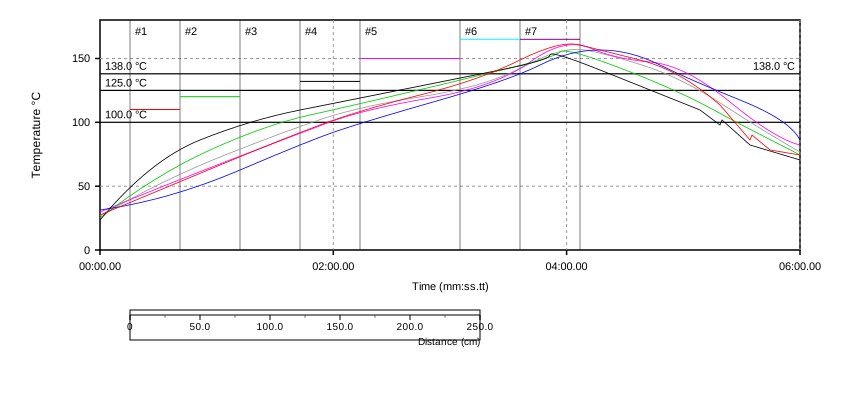
Figure #1 锟?CVP-520 Reflow Profile Envelope
| Typical Reflow Profile Guidelines | |
|---|---|
| Parameter | Guidelines |
| Atmosphere | Air or N2 |
| SnBiAg (42/57.6/0.4) alloy | 138 掳C (near eutectic) |
| Setting Zone | Optimal Dwell Period |
| 40 to 138 掳C | 2:10 to 4:00 minutes |
| 125 to 138 掳C | 0:30 to 1:30 minutes |
| 100 to 138 掳C | 1:15 to 2:00 minutes |
| TAL (138 掳C) | 0:30 to 1:30 minutes |
| Peak temperature | 155 to 180 掳C |
| Joint cool down rate from 170 掳C | Up to -3 掳C/sec |
Storage & Handling
ALPHA CVP-520 should be stored in a refrigerator upon receipt at 0 to 10 掳C (32 to 50 掳F). ALPHA CVP-520 should be permitted to reach room temperature before unsealing its package prior to use (see handling procedures on page 4). This will prevent moisture condensation build up in the solder paste.