
Product Overview
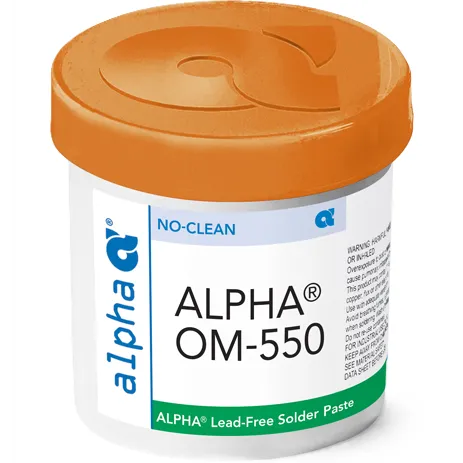
ALPHA® OM-550 is a lead-free, zero-halogen, no-clean, low-temperature solder paste formulated with the novel HRL1 non-eutectic Bi-Sn alloy. Compared to traditional low-temperature alloys, the HRL1 alloy delivers vastly superior drop shock resistance and thermal cycling reliability performance.
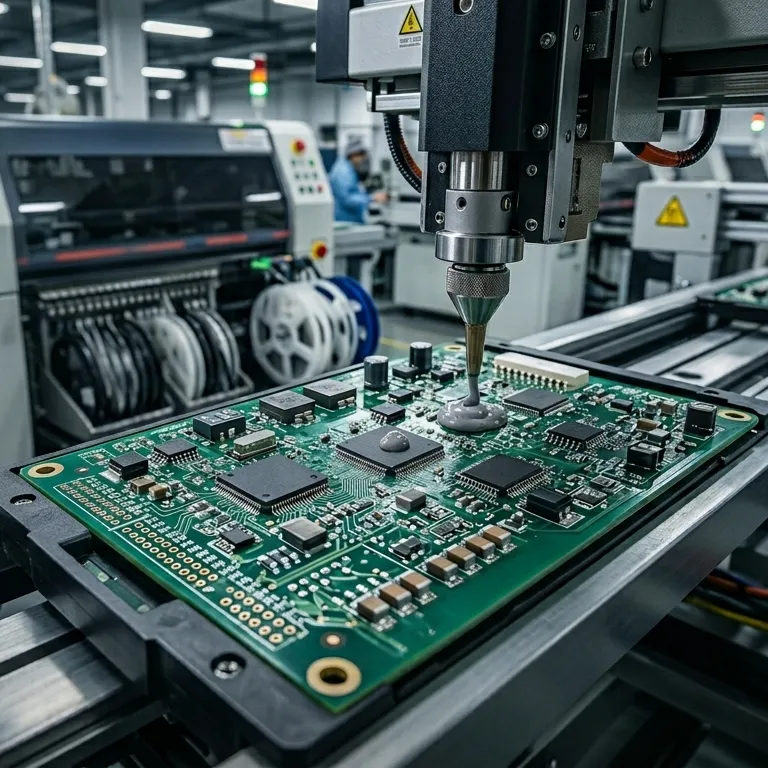
This carefully balanced flux and alloy system exhibits excellent printing characteristics and modern solder paste rheology, minimizing Non-Wet-Open (NWO) and Head-in-Pillow (HIP) defects during low-temperature reflow. With peak reflow temperatures as low as ~175°C, it helps mitigate package and board warpage by up to 99%.
Note: All components used with ALPHA OM-550 must be lead-free to eliminate the formation of tin/lead/bismuth intermetallic which has a melting point under 100 ºC.
Improved Reliability
ALPHA OM-550 HRL1 is a high reliability, low temperature solder paste designed to increase production yield and reduce component warpage. The ALPHA HRL1 alloy has a melting point significantly lower than SAC 305 and was designed to exhibit improved drop shock and thermal cycling performance. A minimum peak temperature of only 185°C vs 245°C reduces energy consumption in the SMT process.
Note: Drop Shock and Peak Reflow Window charts are in the detailed specifications below.
Product Features

View Detailed Product Parameters
Product Information
Technical Specifications
| Category | Results | Procedures/Remarks |
|---|---|---|
| Chemical Properties | ||
| Activity Level | ROL0 | IPC J-STD-004B |
| Halide Content | Pass (Halide-free) | IPC J-STD-004B |
| Fluoride Test | Pass | IPC J-STD-004B |
| Halogen Test | Pass | Zero-Halogen |
| Silver Chromate Test | Pass | IPC J-STD-004B JIS-Z-3197-1999 8.1.4.2.3 |
| Copper Mirror Test | Pass | IPC J-STD-004B JIS-Z-3197-1999 8.4.2 |
| Copper Corrosion Test | Pass | IPC J-STD-004B JIS-Z-3197-1999 8.4.1 |
| Electrical Properties | ||
| SIR (7 days, 40 °C/90% RH, 12V bias) | Pass | IPC-TM-650 2.6.3.7 (J-STD-004B) |
| Bellcore SIR | Pass | Bellcore GR-78 Core Issue 1, Sept 1997 (Chapter 13) |
| Electromigration | Pass | IPC-TM-650 (2.6.14.1), according to J-STD-004B standard |
| Bellcore Electromigration | Pass | Bellcore GR78-CORE (Pass criteria: Final > Initial/10) |
| Physical Properties | ||
| Color | Clear, colorless flux residue | - |
| Tack Force vs. Humidity | Pass | JIS-Z-3284-3:2014, 4.5 IPC J-STD-005 |
| Solderball | Excellent | IPC J-STD-005 |
| Spread | >80% | JIS-Z-3198-3 |
| Wetting Time | Pass | Rhesca Test, Zero cross time T0 |
| Stencil Life | >12 hours | 50% RH, 23 °C (74 °F) |
| Cold/Print Slump | No bridging | JIS-Z-3284-3:2014, 4.3 IPC J-STD-005 |
| Hot Slump | No bridging | JIS-Z-3284-3:2014, 4.4 IPC J-STD-005 |
| Dryness Test (Talc) | Pass | JIS-Z-3197-1999 8.5.1 |
Processing Guidelines
| Storage & Handling | Printing | Reflow (See Figure #1) | Cleaning |
|---|---|---|---|
|
Stencil: Recommended ALPHA CUT or ALPHA FORM stencils @ 0.050mm to 0.150 mm (4-6 mil) thick for 0.4 to 0.5 mm (0.016" or 0.020") pitch. Stencil design is subject to many process variables. Contact your local Alpha stencil site for advice. Squeegee: Metal (recommended) Pressure: 1.5 lb/in (Alpha test result) Speed: 100 mm/sec (Alpha test result) Paste Roll Diameter: 1.5-2.0 cm, make additions when roll reaches 1cm (0.4") diameter (min.). Max roll size depends on blade type. Stencil Release Speed: Up to 7 mm/sec Lift Height: 8-14mm (0.31-0.55") |
Atmosphere: Clean-dry air or nitrogen atmosphere is recommended. Profile (HRL1 Alloy): The following reflow profile has been proven to yield good joints, though other profiles may also work. *Note 1 & 2 Ramp Rate: 40-100 °C, 1-3 °C/s Soak: 100-120 °C, 60-100s Time Above Liquidus: >151 °C, 80-120s Peak Temp: 185 - 195 °C Aperture volume/BGA sphere volume ratio: 0.4-0.6 (recommended) |
ALPHA OM-550 residue is designed to remain on the board after reflow. Misprints and stencil cleaning may be done with ALPHA SM-110E, ALPHA SM-440 or ALPHA BC-2200 cleaners. |
Reflow Profile Recommendations
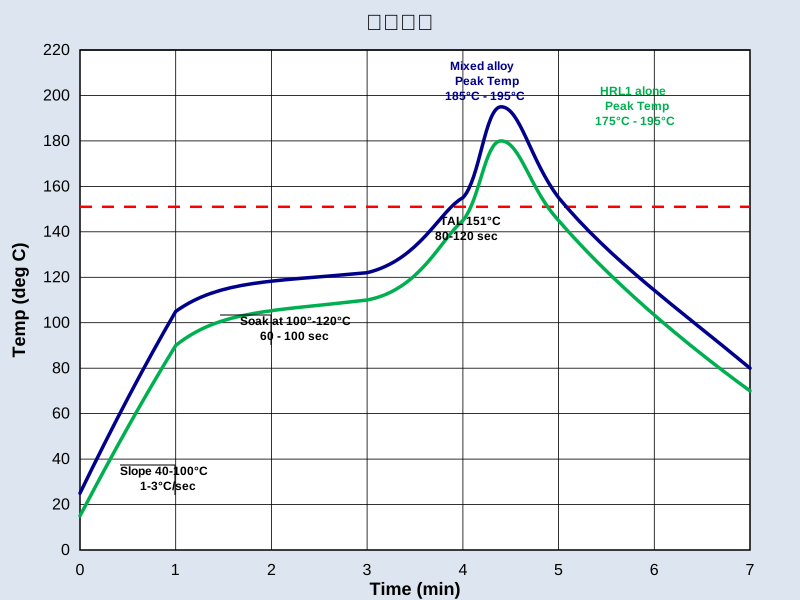
Recommended Reflow Profile: Mixed SAC/HRL1 Joint and HRL1 (Solder Only) Joint
*Note 1: Lower peak reflow temperatures require an adjusted/extended dwell above liquidus to form proper joints. Fine-tuning based on PCB design is required for optimum performance. The profile above represents a single exposure profile. For assemblies requiring multiple reflow exposures, please contact your local Alpha representative.
**Note 2: Peak reflow temperatures of 185°C–195°C are recommended for mixed SAC/HRL1 joints.
The ratio of solder paste volume to BGA sphere volume recommended for this profile is 0.4-0.6.
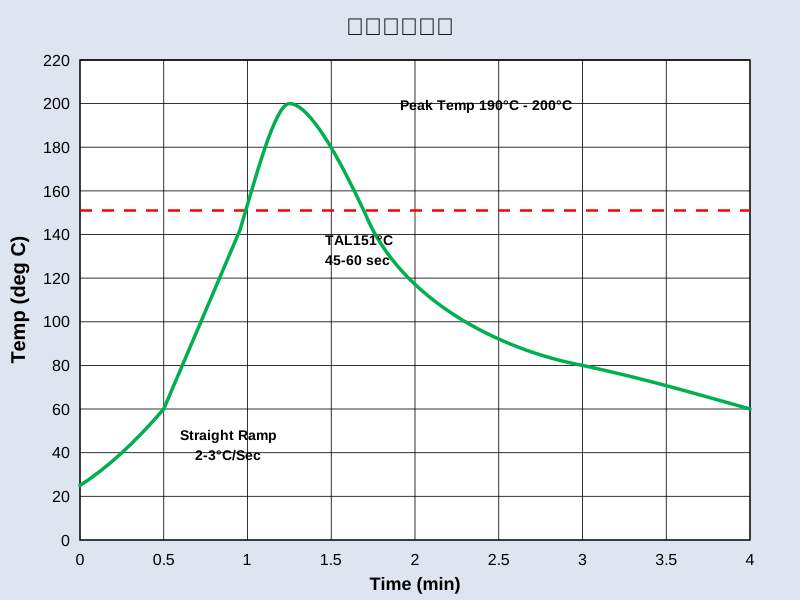
***Note 3: Straight ramp profile is only for HRL1 solder only joints.