Product Overview
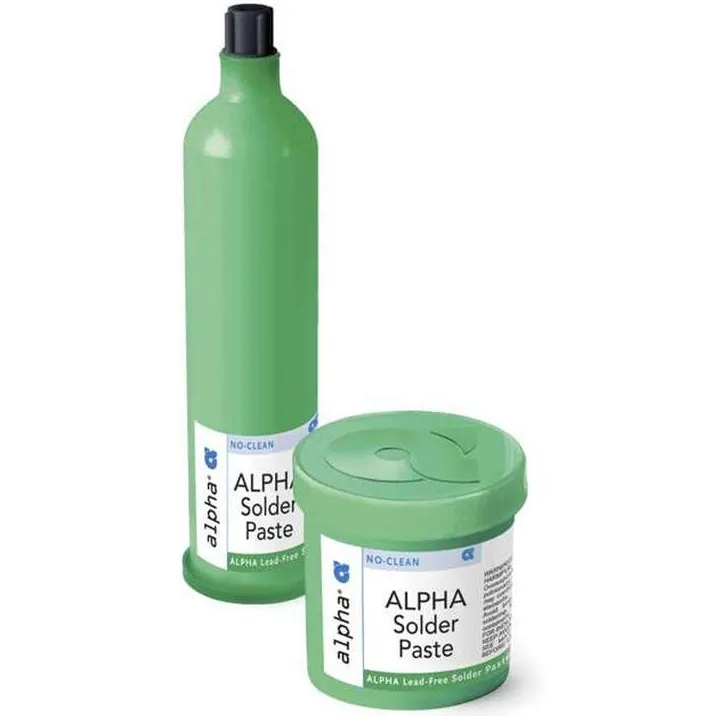
ALPHA® OM-100 SnCX 07 is a silver-free solder paste designed to provide reliability comparable to tin-silver-copper (SAC) alloys while significantly improving the total cost of ownership (TCO). This solution is ideal for cost-sensitive applications, enhancing your profitability in every electronics assembly.
Compared to SAC305-based solder pastes, ALPHA OM-100 SnCX 07 exhibits an average of 50% higher resistance to mechanical strain. It significantly extends the service life of major home appliances and smart home electronics, performing exceptionally well under environmental challenges such as vibration and drop shock.
This versatile solder paste combines outstanding performance and cost efficiency, maximizing value without compromising on reliability.
Core Advantages
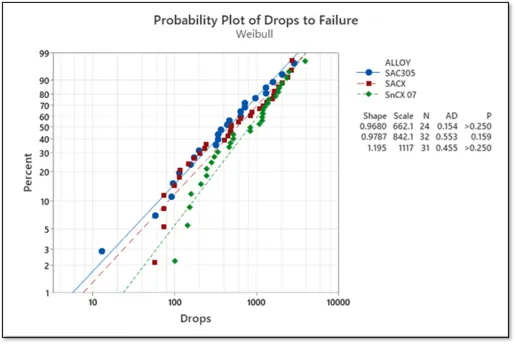
Excellent Mechanical Performance: Proven to extend characteristic lifetime by 50% compared to SAC305 in major home appliances and smart consumer electronics, providing up to 40% improvement in drop shock and vibration performance.
Total Cost of Ownership (TCO) Optimization: Saves up to 30% in metal costs compared to tin-silver-copper (SAC) based alloys, optimizing overall costs and improving profit margins.
Reliable Thermal Cycling (TCT) Performance: For operating environments below 100 °C, it delivers thermal cycling performance comparable to SAC305, meeting the reliability requirements of most home appliances.
Excellent Processability: Optimized for more challenging process windows, offering stencil life of up to 16 hours.
Performance & Test Animations
Significant Cost Optimization with Guaranteed Thermal Cycling Reliability
While ALPHA OM-100 SnCX 07 delivers significant material cost savings (up to 30% metal cost reduction) to your electronic manufacturing process, it still provides thermal cycling performance (TCT) comparable to SAC305 for smart home products operating below 100 °C, ensuring long-term stability and reliability.
View Detailed Product Parameters
Product Information
Technical Data
| Category | Results | Procedure/Remarks |
|---|---|---|
| Chemical Properties | ||
| Flux Classification | ROL0 | IPC J-STD-004B |
| Halide Content | Halide-free (by titration) Passes Silver Chromate Test |
IPC J-STD-004B |
| Halogen Content | Pass, Halogen-Zero - No intentionally added halogens | EN14582 |
| Copper Mirror Test | Pass, low activity, no breakthrough | IPC J-STD-004B |
| Copper Corrosion Test | Pass, low activity, no corrosion | IPC J-STD-004B |
| Electrical Properties | ||
| Surface Insulation Resistance (IPC 7 Days, 40 °C/90% RH) |
Pass, 7 Days ≥ 10⁸ Ω | IPC J-STD-004B |
| Surface Insulation Resistance (IPC 7 Days, 85 °C/85% RH) |
Pass, 7 Days ≥ 10⁸ Ω | IPC J-STD-004C |
| Physical Properties | ||
| Color | Clear, colorless flux residue | - |
| Tack Force Life | Pass, < 1 g/mm² change over 24 hours at 25 ± 2 °C and 50 ± 10% RH | IPC J-STD-005 TM-650 2.4.44 |
| Solder Balling | Acceptable | IPC J-STD-005 |
| Stencil Life | 16 hours | 50% RH, 25 °C (74 °F) |
| Cold Slump (25 °C / 50% RH) | Pass, no bridging at 0.20 mm gap and above | IPC J-STD-005A |
| Pass, no bridging at 0.20 mm gap and above | JIS Z 3284:1994 Annex 7 | |
| Hot Slump (150 °C / 10 mins) | Pass, no bridging at 0.25 mm gap and above | IPC J-STD-005A |
| Pass, no bridging at 0.30 mm gap and above | JIS Z 3284:1994 Annex 8 | |
Halogen Levels
| Halogen Standards | |||
|---|---|---|---|
| Standard | Requirement | Test Method | Status |
| JEITA ET-7304 Definition of Halogen-Free Soldering Materials |
Br, Cl, F content in soldering material solids < 1000 ppm | TM EN 14582 | Pass |
| IEC 61249-2-21 | Br or Cl content from flame retardants in post-soldering residue < 900 ppm, or total < 1500 ppm | Pass | |
| JEDEC Guidelines for Defining "Low Halogen" Electronics |
Br or Cl content from flame retardants in post-soldering residue < 1000 ppm | Pass | |
| Halogen-Zero: No halogen compounds are intentionally added to this product. | |||
Application Guidelines
The following process parameters serve as a general guide for a typical SMT process window. Due to variations in assembly processes within the electronics manufacturing industry, the optimal settings for each process should be evaluated individually.
Stencil: A thickness of 0.10 mm (4.0 mil) was internally tested during product development. Stencil design is influenced by many process variables. Please contact your local MacDermid Alpha technical support department for recommendations.
Aperture Design: ALPHA OM-100 SnCX 07 solder paste can be printed using various aperture designs. Optimal printing results are obtained with an Area Ratio (AR) ≥ 0.59.
Squeegee: Metal squeegees are recommended, at angles of 60° or 45°.
Speed: Suitable for stencil printing at speeds between 50 mm/s (2.0 in/s) and 150 mm/s (6.0 in/s).
Pressure: Depending on print speed and the seal between the stencil and the substrate, the typical squeegee pressure for a 30 cm (12 in) squeegee length is 0.18 kg/cm (1.0 lbs/in) to 0.29 kg/cm (1.6 lbs/in). Applications requiring higher printing speeds will need higher blade pressures to ensure a clean stencil surface.
Solder Paste Roll Diameter: A diameter between 1.5 cm (0.60 in) and 2.0 cm (0.80 in) is recommended for optimal performance. Add fresh solder paste when the roll diameter reaches 1.0 cm (0.40 in) or less. The maximum roll size varies by squeegee.
Separation Speed: Recommended separation speed is >5.0 mm/s.
DEK ProFlow® compatibility certified.
Storage and Handling: Refrigerate at 0-10 °C (32 - 50 °F) to ensure stability. Under these storage conditions, ALPHA OM-100 SnCX 07 has a shelf life of 6 months. After refrigeration, allow the solder paste container to warm up to room temperature for 4 hours. Prior to use, the solder paste temperature must be ≥19 °C (66 °F). It is recommended to verify the solder paste temperature with a thermometer before loading it onto the printer to ensure it has reached or exceeded 19 °C (66 °F).
Note: Do not mix used solder paste removed from the stencil with unused solder paste in the jar, as this will alter the rheological properties of the unused paste.
Recommended Reflow Profile
ALPHA OM-100 SnCX 07 Typical Reflow Profile Recommendations
Soak Profile:
Straight Ramp Profile:
These guidelines are recommendations based on best practices. The typical reflow profiles provided were tested in a laboratory and achieved acceptable performance. Users are still required to optimize the profile for their specific board applications to ensure the best results.
Product Documentation
ALPHA® OM-100 SnCX® 07 Solder Paste TDS
Simplified Chinese
ALPHA® OM-100 SnCX® 07 Solder Paste TDS
English
Striking a Balance Flyer
Simplified Chinese
Striking a Balance Flyer
English
ALPHA® OM-100 SnCX® 07 Solder Paste Brochure
Simplified Chinese
ALPHA® OM-100 SnCX® 07 Solder Paste Brochure
English