
Product Overview
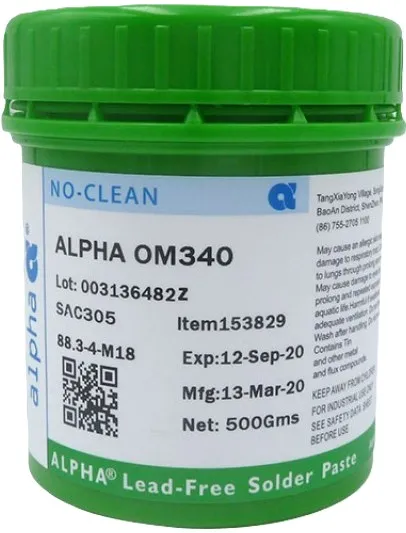
ALPHA® OM-340 is a broad utility, lead-free, no-clean solder paste designed to offer industry-leading head-in-pillow (HoP) defect prevention and first-pass in-circuit testing yields. It exhibits excellent print consistency, particularly in high-yield and ultra-fine pitch repeatability applications.
The wide reflow window ensures outstanding coalescence across various deposit sizes on CuOSP finishes, with excellent resistance to random solder balling and mid-chip solder balls. ALPHA OM-340 delivers excellent joint cosmetics and industry-best pin-testability. Its IPC 7095 Class III voiding performance and ROL0 IPC classification ensure optimal long-term reliability.
Product Features

View Detailed Product Parameters
Product Information
Application Guidelines
Designed for standard and fine-pitch stencil printing. Print speeds range from 25 mm/sec (1 in/sec) to 150 mm/sec (6 in/sec). Recommended stencil thickness ranges from 100 μm (4 mil) to 150 μm (6 mil), particularly when paired with ALPHA stencils. Squeegee pressure should be set between 0.18-0.27 kg/cm (1.0-1.5 lbs/in) depending on the printing speed. Higher print speeds require higher squeegee pressure. The wide reflow window guarantees high first-pass yield, good cosmetics, and minimized rework.
Technical Specifications
| Category | Results | Procedures / Remarks |
|---|---|---|
| Chemical Properties | ||
| Flux Classification | ROL0 | IPC J-STD-004B |
| Halide Content | Halide-free (by titration). Passes silver chromate paper test. | IPC J-STD-004B |
| Halogen Content | Pass Completely halogen-free (no halogen deliberately added) | EN14582 |
| Copper Mirror Test | Pass, low activity, no breakthrough | IPC J-STD-004B |
| Copper Corrosion Test | Pass, low activity, no corrosion | IPC J-STD-004B |
| Electrical Properties | ||
| SIR (IPC 7 Days, 85 °C/85% RH) | Pass (≥10⁸ ohm) | IPC J-STD-004A |
| SIR (IPC 7 Days, 40 °C/90% RH) | Pass (≥10⁸ ohm, 7 days, down to 100 µm pitch) | IPC J-STD-004B |
| SIR (IPC 7 Days, 85 °C/85% RH) | Pass (≥10⁸ ohm, 7 days) | IPC J-STD-004C |
| SIR (Bellcore 96 Hours, 35 °C/85% RH) | Pass (≥ 10¹¹ ohm) | GR78-CORE |
| Electromigration (Bellcore 96 Hours, 65 °C/85% RH, 10V 500 Hours) | Pass (Final value > Initial value / 10) | GR78-CORE |
| Physical Properties | ||
| Color | Flux residue is colorless and transparent | |
| Tack Life | Pass, change <1 g/mm² after 24 hours at 25±2 °C and 50±10% RH | IPC J-STD-005, TM-650 2.4.44 |
| Pass, change <10% after 24 hours at 25±2 °C and 50±10% RH. | JIS Z 3284 Annex 9 | |
| Solder Balling | Acceptable (SAC 305 and SAC405 alloys) | IPC J-STD-005 |
| Pass, Class 1 - 1 hour and 72 hours | DIN Standard 32 513, 4.4 | |
| Stencil Life | 8 Hours | Test conditions: 50% RH, 25 °C (74 °F) |
| Spread | Pass | JIS Z 3197:1999 8.3.1.1 |
| Cold Slump (25 °C / 50% RH) | Pass, no bridging at 0.20 mm gap and above | IPC J-STD-005A |
| Pass, no bridging at 0.20 mm gap and above | JIS Z 3284:1994 Annex 7 | |
| Hot Slump (150 °C / 10 min) | Pass, no bridging at 0.25 mm gap and above | IPC J-STD-005A |
| Pass, no bridging at 0.40 mm gap and above | JIS Z 3284:1994 Annex 8 | |
Halogen Status
| Standard | Requirements | Test Method | Status |
|---|---|---|---|
| JEITA ET-7304 Definition of halogen-free soldering materials |
Bromine, chlorine, fluorine content in soldering material (solid) less than 1000 ppm | TM EN 14582 | Pass |
| IEC 612249-2-21 | Concentration of bromine or chlorine in residues less than 900 ppm, or total concentration less than 1500 ppm | Pass | |
| JEDEC Guidance defining "low-halogen" electronics |
Concentration of bromine or chlorine in residues less than 1000 ppm | Pass | |
| Zero Halogen: - No halogen deliberately added to the formulation. | |||
Process Guidelines
| Storage & Handling | Printing | Reflow (Figs 1 & 2) | Cleaning |
|---|---|---|---|
|
Stencils: ALPHA CUT, ALPHA NICKEL-CUT, ALPHA TETRABOND®, or ALPHA FORM stencils are recommended. Thickness 0.100 - 0.150 mm (4-6 mil), pitch 0.4 - 0.5 mm (16-20 mil). Squeegee: Metal (recommended). Roll Diameter: Maintain between 1.5 - 2.0 cm. Add fresh paste when it falls below 1 cm (0.4"). Pressure: 0.45 - 0.7 kg/cm (0.8 - 1.5 lbs/linear inch). Speed: 25 - 150 mm/sec (1 - 6 in/sec). Release Speed: 3 - 10 mm/sec. Verify under magnification to prevent peaking or missing paste. Enclosed Head: Compatible with DEK ProFlow® system. |
Environment: Clean, dry air or nitrogen. Profiles (SAC Alloys): Minimum coalesce size down to 8 mil (200 µm). IPC Class III voiding performance (applicable to both ramp and soak profiles). Compatible with most board finishes (ENTEK HT, ENTEK OM, Alpha Star, ENIG, SACX HASL). Note 2: Refer to component/PCB vendor datasheets for thermal-dynamic properties. If peak temperature is lowered, extend time-above-liquidus (TAL). Peak temperature of 240 °C helps minimize voiding. |
ALPHA OM-340 residues can be left on the board. If cleaning is required, water-based cleaners are recommended:
Manual/solvent cleaning:
Misprint and stencil cleaning:
|
These are basic recommendations; individual processes should be evaluated separately.
Recommended Reflow Profiles
Recommended Reflow Profiles for ALPHA OM-340 SAC305 & Innolot
Soak Profile: SAC305 & Innolot
Ramp Profile: SAC305 & Innolot
Safety & Warnings
Operators are advised to read and review the Safety Data Sheets (SDS) for health and safety warnings before use.